
Let's just say it.
Most prop firms are terrible at marketing.
Not because they don't spend money. They spend plenty.
Not because they don't have agencies. Most have tried two or three by now.
And not because they don't care. They care a lot. Revenue is on the line.
They're terrible at marketing because prop firms are built by traders and engineers.
People who think in spreads, drawdown limits, and platform integrations.
People who understand risk management better than anyone in the room.
But when it comes to persuading a stranger on the internet to hand over $300 for a challenge they have a 90% chance of failing?
That's a different skill set entirely.
And most firms don't have it.
So what happens?
The marketing defaults to the same playbook everyone else is running.
Same ads. Same discounts. Same "get funded today" copy. Same stock images of charts going up and to the right.
And the CEO wonders why CAC keeps climbing while conversion rates flatten.
Here's the real answer.
And it's not "spend more."
Sin #1: You Look Like Every Other Prop Firm
Pull up five prop firm websites right now. Go ahead.
You'll see the same hero section.
A trader staring at charts.
Maybe a city skyline at night.
A headline that says something about getting funded or trading with their capital.
A button that says "Start Your Challenge."
Now tell me which firm you're looking at without reading the logo.
You can't.
That's the problem.
When every firm looks, sounds, and feels the same, the only differentiator left is price.
And we already talked about why competing on discounts is a losing game. When the only reason a trader picks you is because you're $20 cheaper, that trader will leave you the moment someone else is $20 cheaper.
The fix isn't a rebrand.
It's a voice.
Every prop firm has a story. A point of view. A reason they exist that isn't "we also sell funded accounts."
Find it. Say it. Say it loudly and repeatedly until your audience can hear your brand in their head without seeing your logo.
That's brand.
And most prop firms don't have one. They have a logo and a color scheme. That's not the same thing.
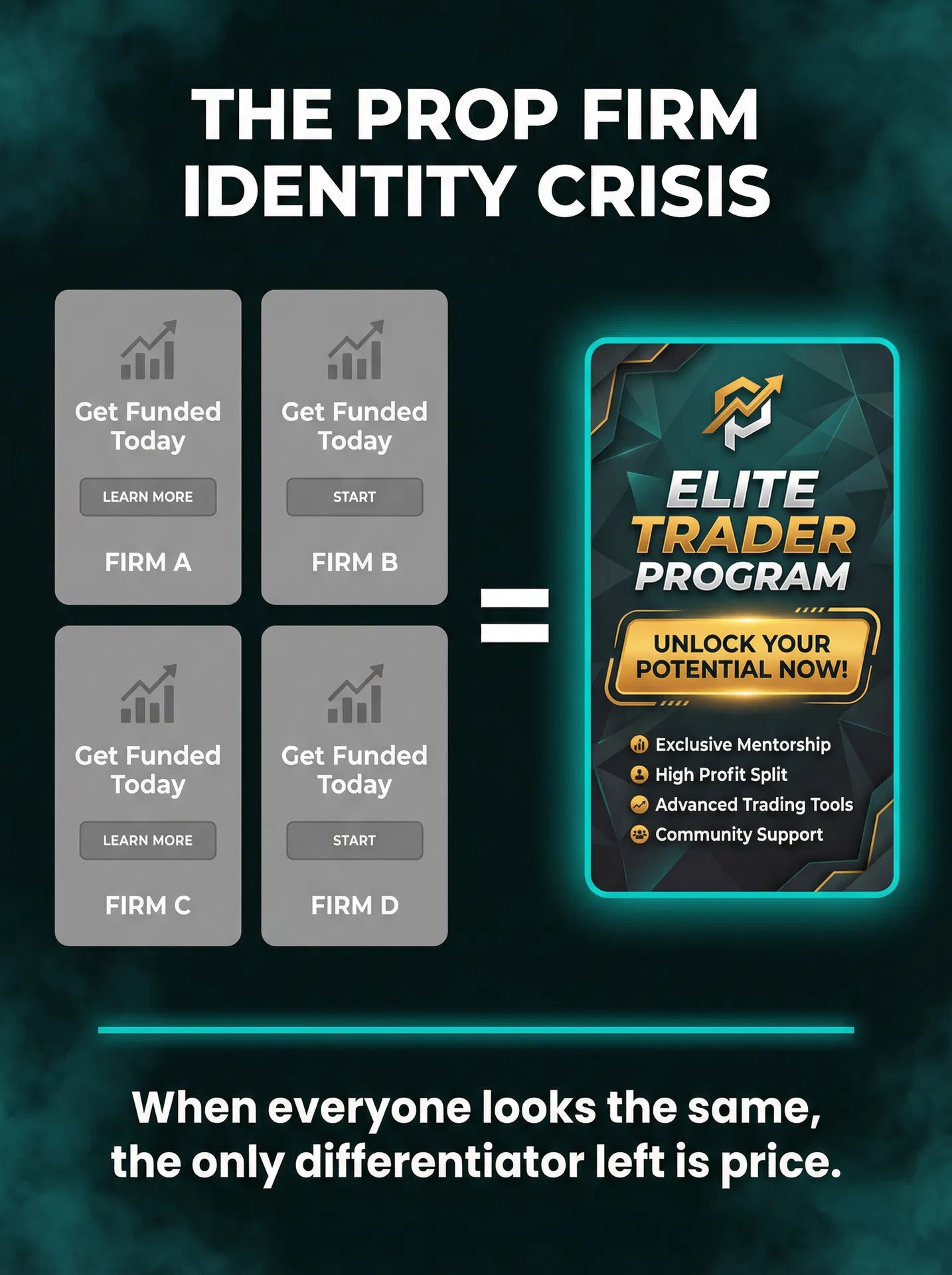
The Prop Firm Identity Crisis
Sin #2: Your Copy Talks to Nobody
"Get funded with up to $200K in trading capital. Pass our evaluation and start trading with our money. Join thousands of successful traders."
Who is this talking to?
Everyone. Which means no one.
Generic copy is the default when a firm doesn't understand who they're actually selling to.
"Males 18-34 interested in trading" is not a persona. It's a census bracket.
The Dream Chaser who just watched a YouTube video about a funded trader buying a Lamborghini needs different messaging than the System Builder who has 200 backtested trades in a spreadsheet.
The Revenge Trader who's been burned by three other firms needs different messaging than the Calculator who's running expected value equations on your challenge pricing.
When you talk to all of them the same way, you convince none of them.
The fix is persona-specific messaging.
Not one landing page. Multiple angles. Multiple hooks. Multiple ad sets targeting different emotional triggers for different buyer types.
This is what we do at FiFuel.
We don't write "prop firm ads." We write ads for specific people at specific stages of their trading journey.
Because the click that leads to a purchase doesn't come from a clever headline. It comes from a trader thinking, "That's literally me."
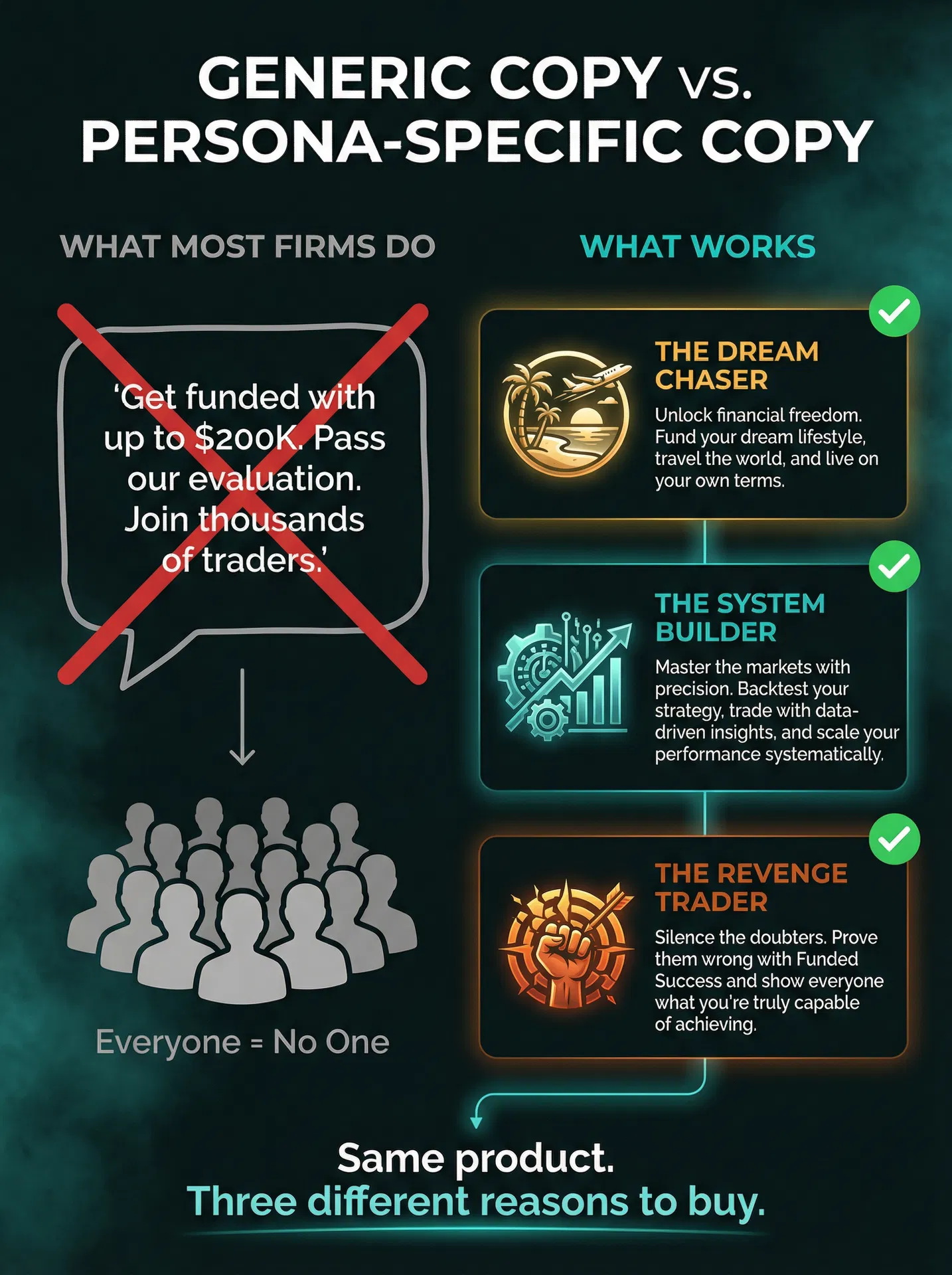
Generic Copy vs. Persona-Specific Copy
Sin #3: Your Ads Are a Guessing Game
Here's how most prop firms "test" creative.
A designer makes five ads. Someone on the team picks the two they like best. Those run for a week. Whichever has the lower CPA "wins."
Repeat.
That's not testing. That's guessing with extra steps.
Real creative testing isolates variables.
You test the visual separately from the copy separately from the offer. You run enough spend to reach statistical significance. You test against a control, not against each other.
And you measure more than just CPA.
Does the ad attract the right type of trader?
Does the creative that wins on click-through also win on purchase rate?
Does it hold up as you scale spend, or does it fall apart past $500 a day?
Most prop firms can't answer any of these questions because they never built a testing framework.
They just launch ads and react.
We break down the full creative testing framework in a separate post.
But the core principle is this: if you can't explain why a creative won, you can't repeat the win.
And if you can't repeat it, you don't have a system. You have luck.
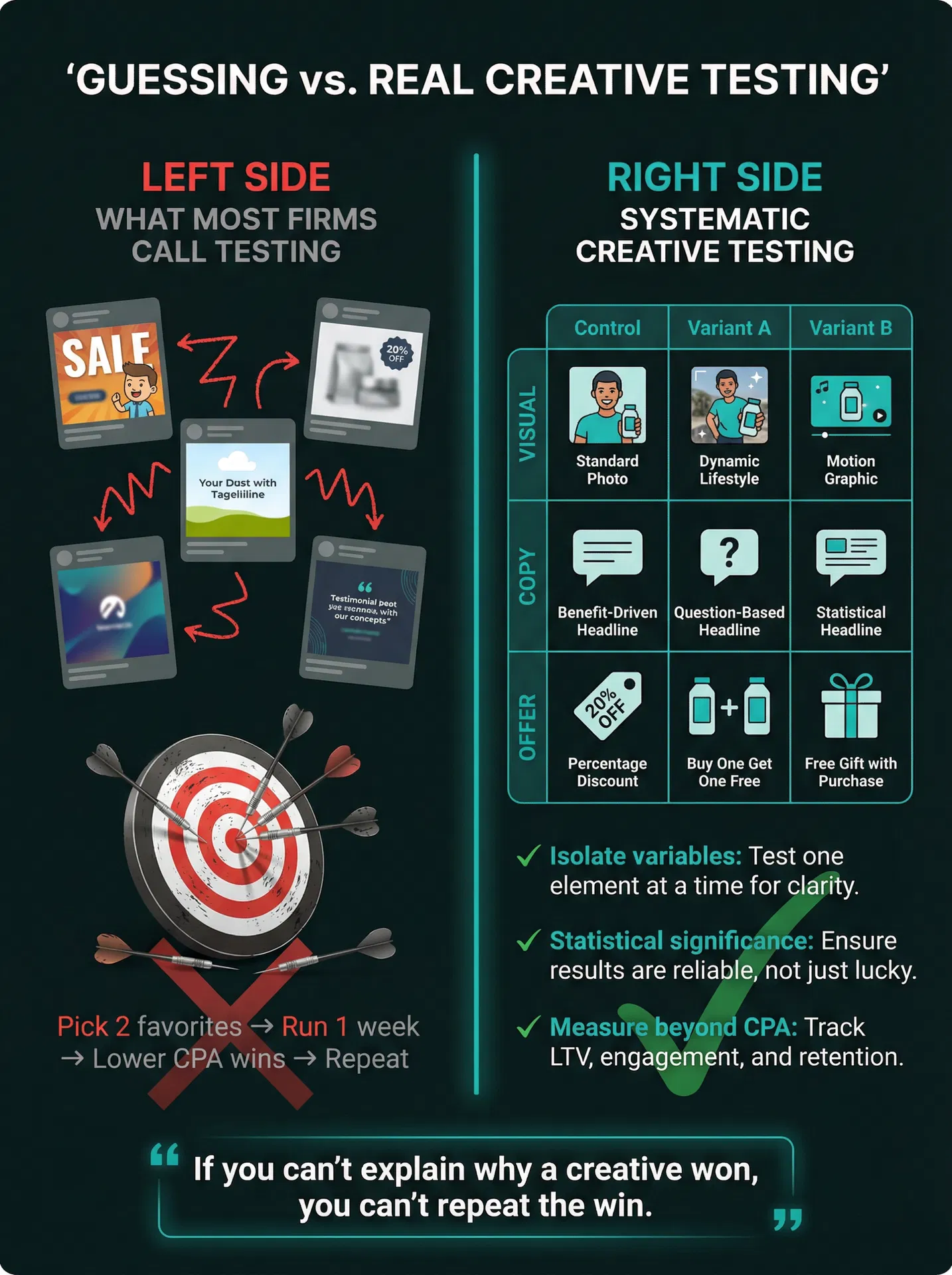
Guessing vs. Real Creative Testing
Sin #4: Your Email Strategy Is "Send a Discount to Everyone"
Open your email platform right now. Look at the last 10 emails you sent.
How many of them were a discount offer to your entire list?
If the answer is more than three, your email strategy isn't a strategy. It's a megaphone.
Email is the highest-ROI marketing channel that exists.
It costs almost nothing to send. The audience already knows who you are. And behavior-triggered emails convert at 3-5x the rate of broadcast blasts.
But most prop firms treat email like a notification system.
"We have a sale." "New product." "Limited time offer." Send to all. Done.
Meanwhile, there's a trader sitting in your database who bought a challenge six weeks ago, failed it, and hasn't heard from you since.
There's another one who opened your last three emails but didn't click.
There's a third who visited your pricing page twice this week but didn't purchase.
Each of those traders needs a different message at a different time.
That's what automated flows do. And most prop firms either don't have them or built them once two years ago and never touched them again.
The fix is building a real email engine.
Welcome sequences. Post-purchase sequences. Post-failure sequences. Win-back sequences. Promotional sequences.
Segmented by behavior, not just by "everyone."
This alone can add 15-25% to a prop firm's revenue without spending a single extra dollar on ads.
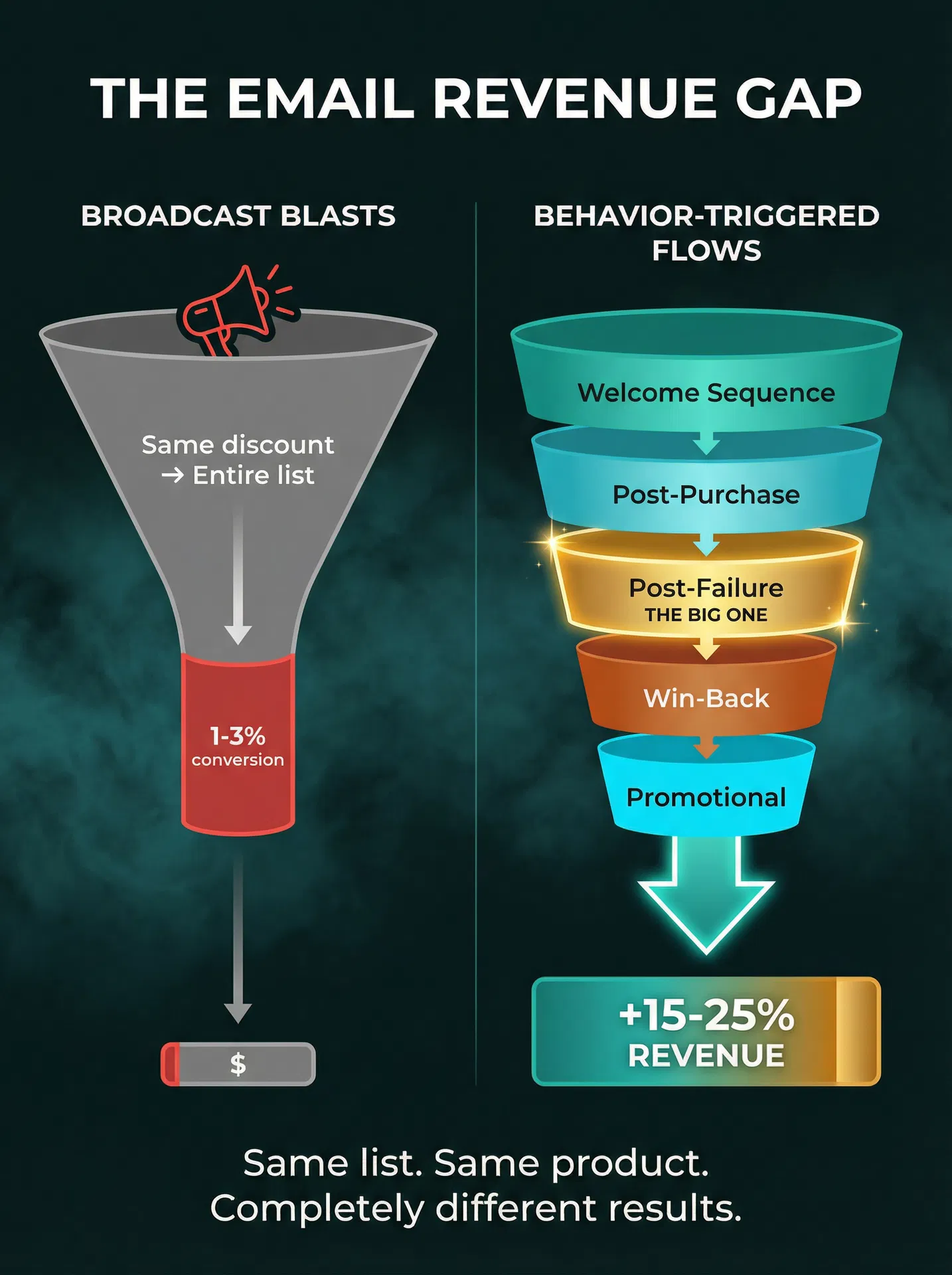
The Email Revenue Gap
Sin #5: You Treat Affiliates Like an Afterthought
"Yeah, we have an affiliate program. It's on the website somewhere."
That's what most prop firms say when you ask about their affiliate channel.
And then they wonder why it only drives 3% of revenue.
Affiliates aren't a passive income stream you set and forget.
They're a channel. And like any channel, they need management, creative, communication, and incentives.
The best prop firm affiliate programs don't just offer a commission rate and a signup link on the footer.
It should be an active growth channel with recruited partners, pre-approved creative assets, compliance guidelines, regular communication, and performance incentives that reward quality over volume.
The firms that do affiliates well are generating 20-40% of their revenue from the channel.
The firms that treat it like an afterthought are generating noise and occasional chargebacks.
The fix isn't complicated. It's just work that most firms don't want to do.
Identify the right affiliates. Onboard them properly. Give them tools. Track their performance.
Cut the ones that send junk traffic. Reward the ones that send buyers.
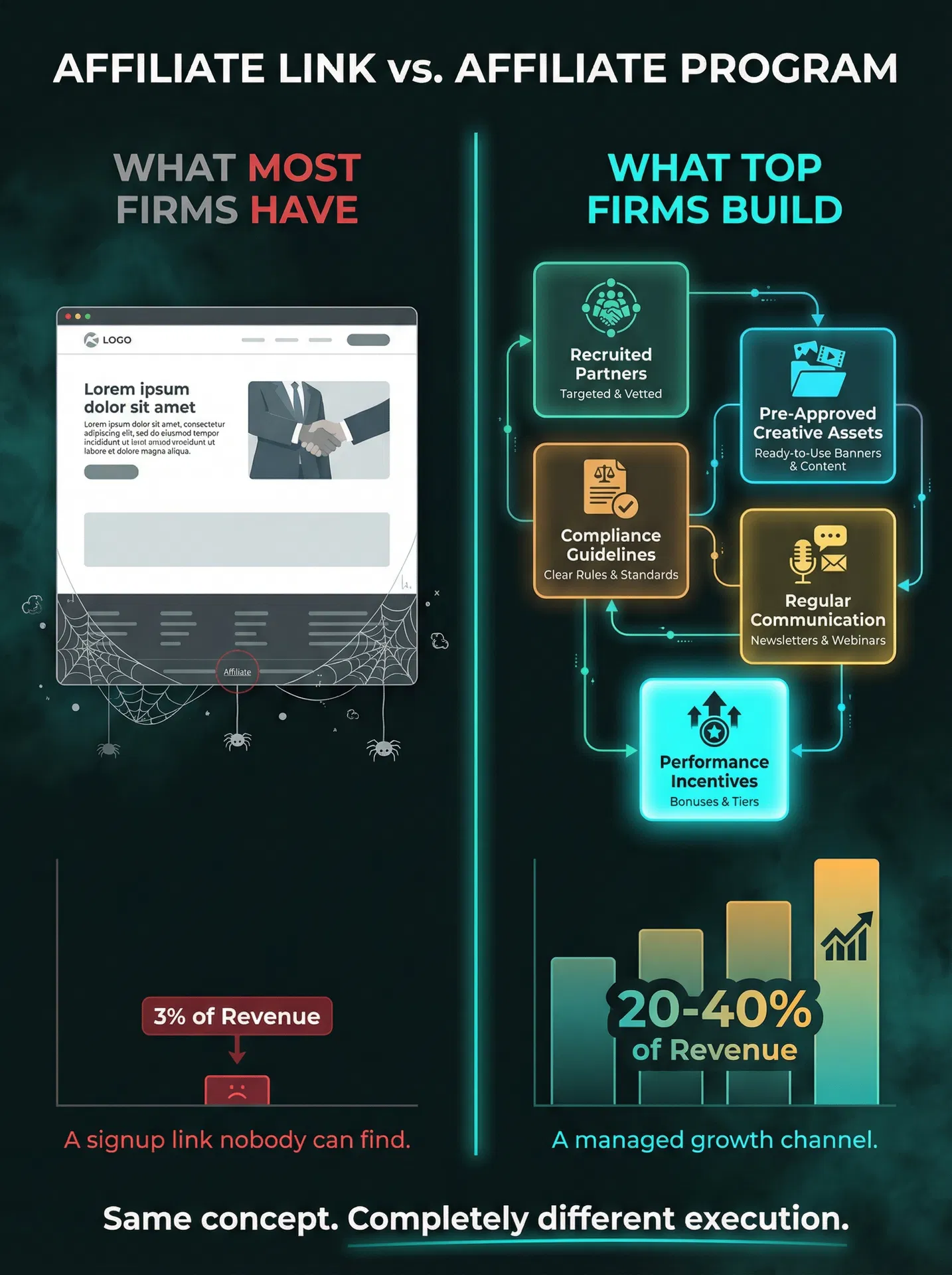
Affiliate Link vs. Affiliate Program
Sin #6: You Have No Brand. Just a Logo.
This one hurts because it's the hardest to fix.
Brand isn't your color palette. Brand isn't your logo. Brand isn't even your tagline.
Brand is the feeling a trader gets when they see your name.
It's the reputation you have in Discord servers and Telegram groups when you're not in the room.
It's whether a trader who's comparing five firms feels something different when they land on your site versus the other four.
Most prop firms have zero brand equity.
They're interchangeable. A trader picks them because of a coupon code, trades the challenge, and couldn't tell you the firm's name six months later.
The firms that survive the current industry shakeout are the ones building real brands.
Not through expensive rebrands or Super Bowl ads.
Through consistency. Through a distinct voice. Through marketing that feels like it was made by humans who understand traders, not by a template machine.
This is why generalist agencies fail prop firms.
They can make things look pretty. They can't make things feel like they belong to your brand.
Because they don't know your brand. They know their own process.
So How Do You Actually Fix It?
Not all at once.
But you start by admitting where you are.
If you're a prop firm running the same ads as everyone else, with the same generic copy, the same discount-heavy offers, the same dead email list, and the same forgotten affiliate program — you don't have a marketing problem.
You have a system problem.
The fix is building a growth engine where every piece works together.
Where your ads feed your email. Where your email drives repeat purchases. Where your offers are strategic instead of reactive. Where your affiliates are managed, not ignored.
And where your brand actually means something.
That's what a marketing system looks like.
And it's the only thing that scales.
We break this down in detail in our growth system post.
But the first step isn't hiring another agency or launching another campaign.
The first step is looking at your marketing honestly and asking: "Would I buy from us?"
If the answer requires a discount code to be "yes," you know what needs to change.
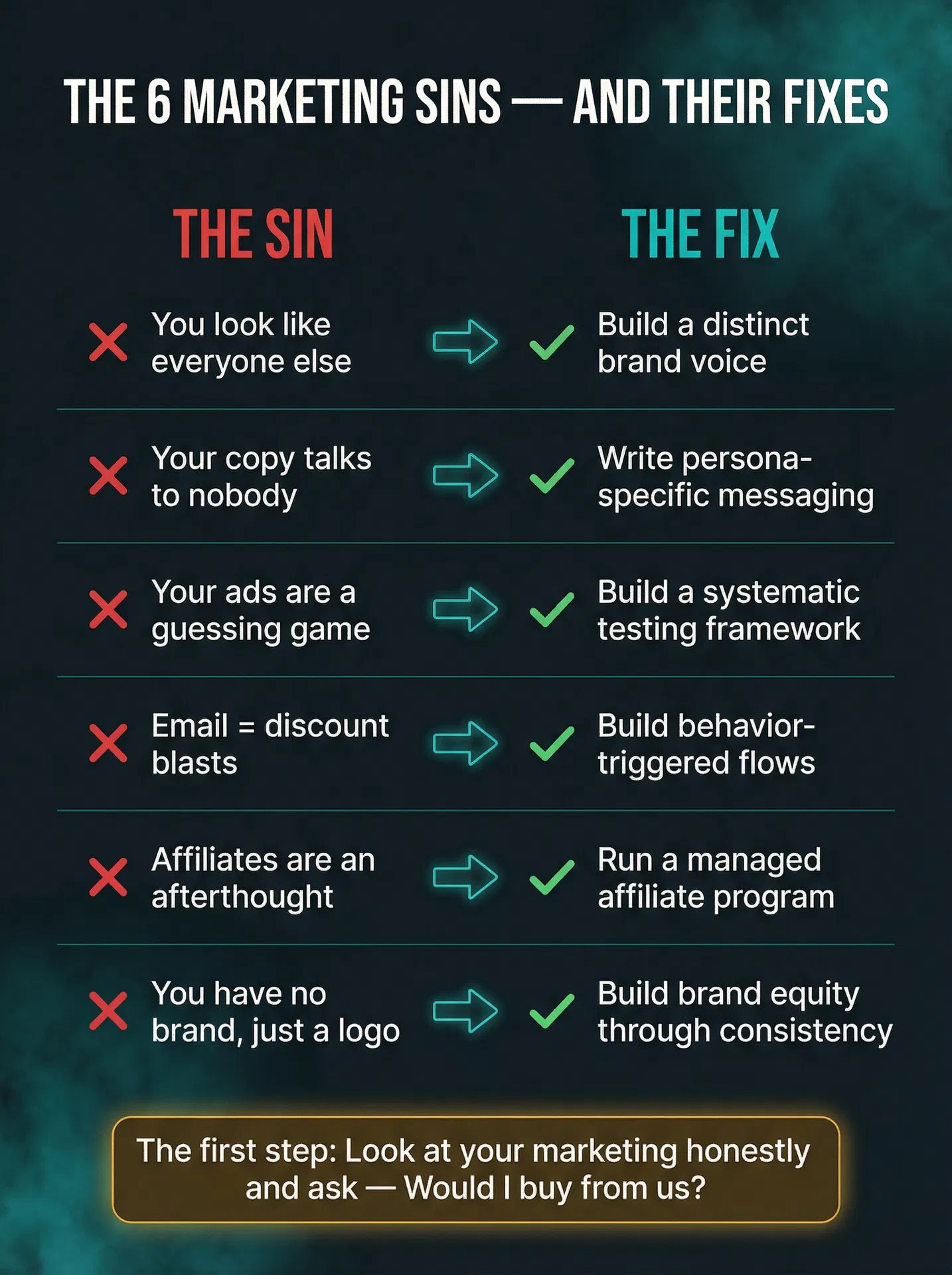
The 6 Marketing Sins — And Their Fixes
---
At FiFuel, we don't do full-service fluff.
We build the ads, the email, the creative systems, and the growth strategy that prop firms actually need.
We bill on revenue, not retainers. Let's talk.