
Most Meta advertisers in finance are not under-tracking.
They're over-believing.
That's the real disease.
Not weak dashboards. Not bad CPMs. Not "the algorithm."
Belief.
Belief that Ads Manager always reflects real business lift. Belief that cheap purchases at low spend mean a campaign is ready to scale. Belief that Meta deserves full credit because someone saw an ad, wandered off into the digital swamp, came back later through branded search or email, and bought anyway.
In financial advertising, that belief gets expensive fast.
Especially in prop firms. Especially in trading education. Especially in any offer where buyers click once, compare five brands, revisit three days later, and finally convert when urgency kicks in.
That is why attribution in this category needs to be treated less like a settings menu and more like a weapon safety manual.
Because if you get it wrong, you can scale a ghost.
And ghosts make terrible customers.
Why attribution matters more for prop firms and financial brands
Prop firm buyers are messy buyers.
They click. They compare. They search your brand later. They revisit from email. They ask around in Discord or Telegram. They wait for a promo. They bounce between channels before they buy.
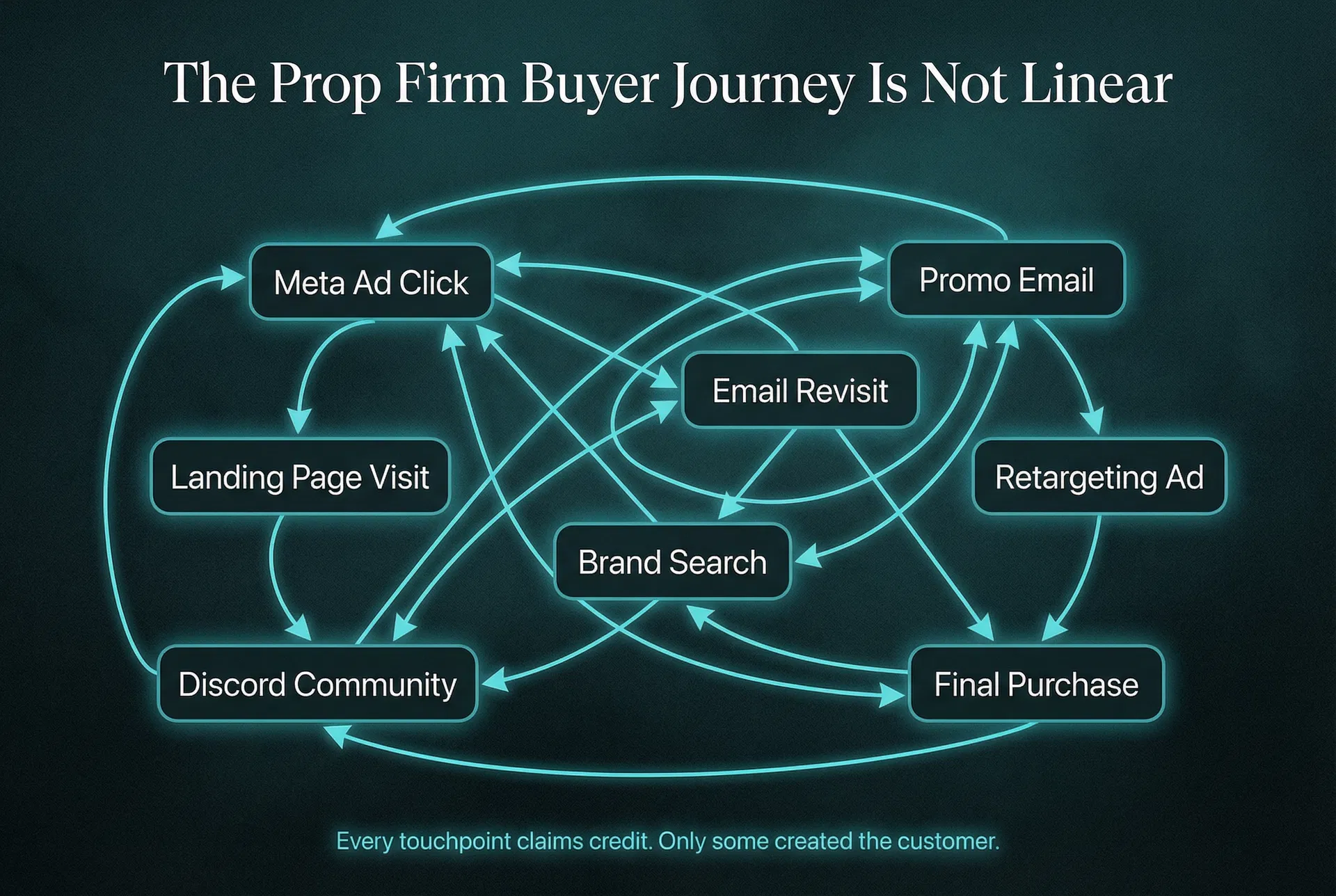
Prop Firm Buyer Journey
That means your Meta attribution setup can either help you understand real acquisition — or flatter the platform for collecting credit after everyone else did the closing.
And financial brands are especially vulnerable to this.
The buying cycle is often longer. The trust barrier is higher. The overlap with search, email, communities, affiliates, and retargeting is heavier. The path to conversion is rarely clean.
This is exactly the dynamic we see across every prop firm account we manage. The firms that understand who they're actually selling to at the persona level have a massive advantage here — because they can separate real acquisition signal from noise.
So the real question is not:
"What setting gives me the prettiest ROAS?"
It's:
"What setting gives me the least delusional view of what's actually scaling?"
That's the better question. Less glamorous. Much more profitable.
The big hot take
For most prop firms and financial brands, the most dangerous attribution setting is not the one that under-reports.
It's the one that makes you feel smarter than you are.
That is why 7dc1dv deserves scrutiny first.
Not 7DC.
And not because 7dc1dv is useless.
Because it is often too generous to trust as the steering wheel.
If your category is full of overlap, delay, and return visits, 7dc1dv can behave like the friend who says he "helped you move" because he texted, "How's it going?" from the parking lot.
Technically present. Operationally decorative.
The three attribution lenses that actually matter
1. 7DC: the practical control
If I'm running Meta for a prop firm or financial brand, 7DC is usually my practical control.
Not because it's perfect. Because it's sane.
It keeps the measurement anchored to click-through behavior without adding the extra haze of view-through credit.
That matters because once view-through enters the room, especially in a category where people revisit through multiple channels, reporting can get much friendlier than reality.
7DC is not truth. But it is often the best baseline for deciding whether an offer, angle, or campaign can hold together as spend rises.
Think of 7DC as the grown-up in the room. Not glamorous. Not mystical. Just less likely to lie to your face.
2. 7dc1dv: the flattering mirror
This is the setting that tends to make marketers feel warm, powerful, and occasionally incorrect.
7dc1dv can be useful as a context layer. It can help you understand broader platform influence. But in prop firms and financial brands, it can also absorb a lot of spillover from:
- returning visitors
- branded search
- promo-driven revisits
- email assistance
- word of mouth
- retargeting bleed
- community chatter
That does not mean every 1-day view conversion is fake. It means this setting is often too eager to wear medals.
Useful for context. Dangerous as leadership.
3. Incremental Attribution: the truth-serum lane
Incremental Attribution is the setting that asks the uncomfortable question:
"How much of this did we actually cause?"
That is why it matters.
It usually looks worse in-platform. That's not a bug. That's the point.
If your standard setup is rewarding campaigns for converting already-warm users, IA is supposed to make some of that shine disappear. Which can feel rude. But useful.
Because when you're trying to find scalable acquisition, less flattery is often more profit.
Meta describes Incremental Attribution as a machine-learning model that optimizes ad delivery for incremental conversions and predicts whether a conversion was caused by an ad.
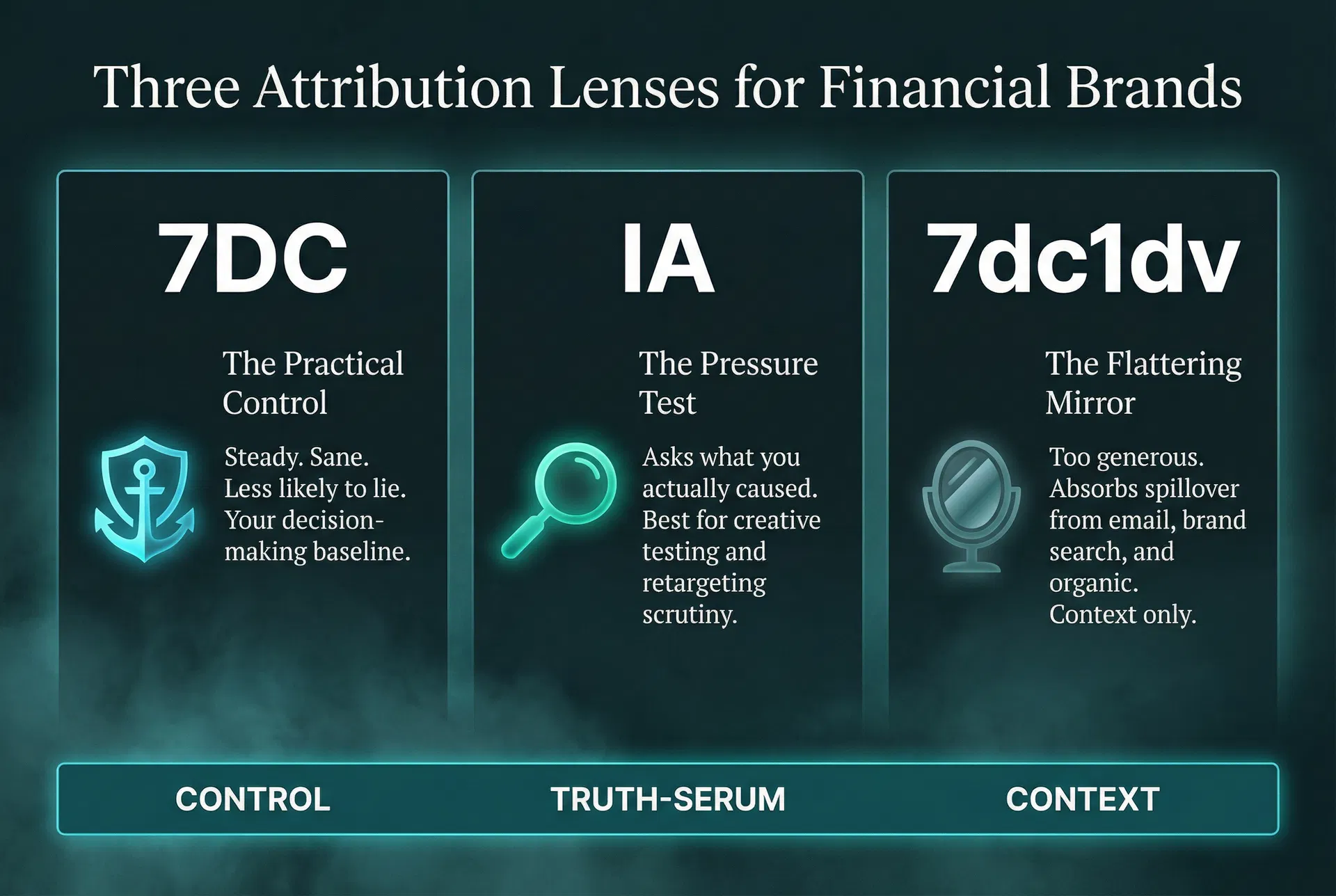
Three Attribution Lenses for Financial Brands
The real trap: cheap purchases at low spend
This is where many financial advertisers get seduced.
You launch at $400 to $1,000 per day.
Purchases come in. ROAS looks decent. Everyone starts feeling clever.
Then you scale.
And suddenly the campaign that looked like a thoroughbred starts coughing like an asthmatic accordion.
Why?
Because low-spend success is often full of low-hanging fruit.
You are not necessarily buying proof of scale. You may simply be harvesting:
- warm demand
- revisit demand
- promo demand
- brand demand
- audience overlap
- delayed conversions Meta is conveniently claiming
This is exactly why attribution discipline matters so much in prop and finance. At small budgets, a campaign can look healthy while quietly feeding on leftovers.
Then once you push spend, the "performance" evaporates because you were picking the nearest fruit. That fruit does not scale forever.
We saw this dynamic play out in reverse with Top One Futures — because we had real audience data from day one, we could validate whether early wins were genuine cold acquisition or just warm overlap. That's the difference between scaling to $9M and scaling a ghost.

False Winner vs True Generator
The framework we use for prop firms
Here is the simplified operating model.
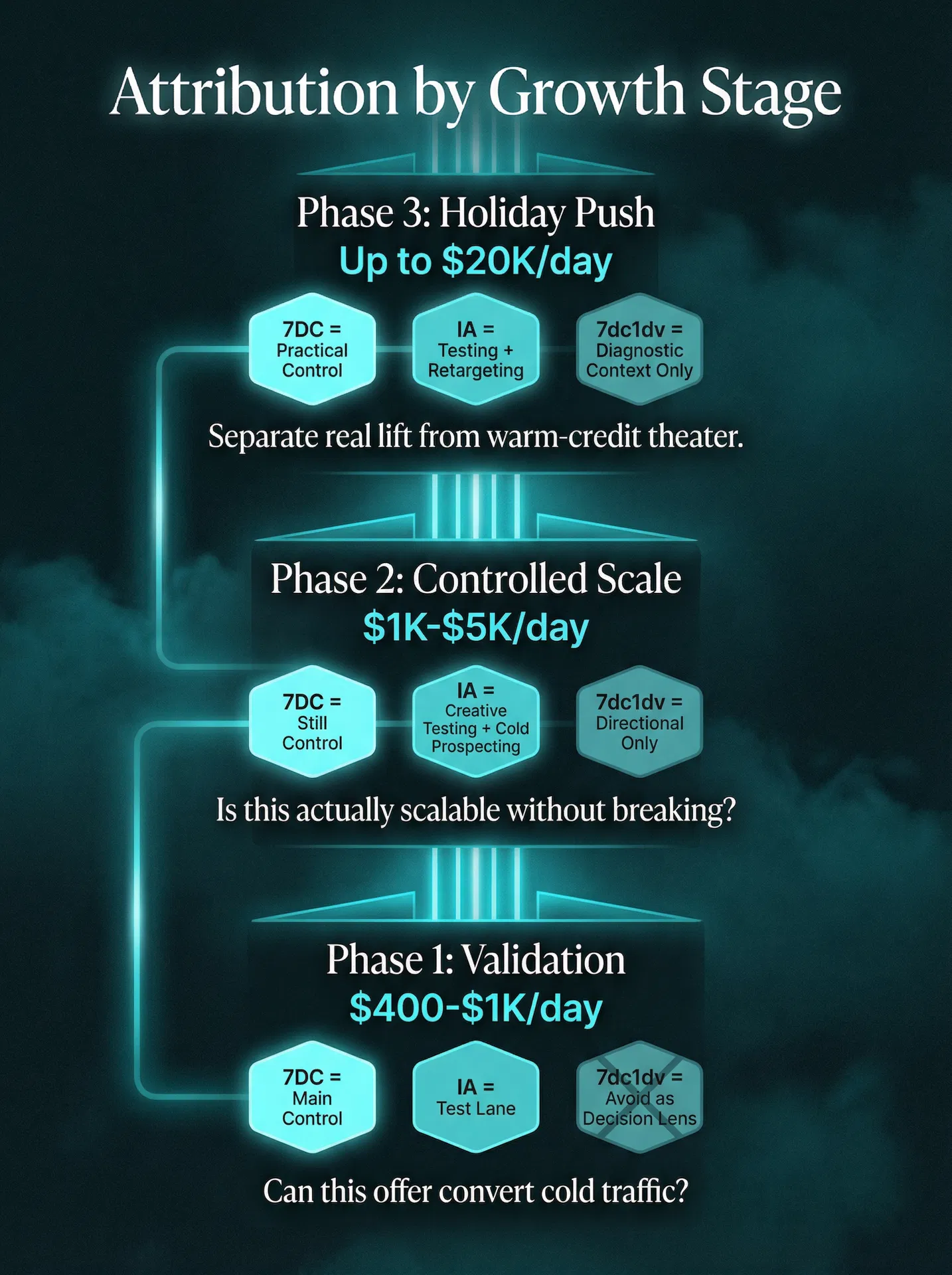
Attribution by Growth Stage
Phase 1: Validation
Budget range: $400 to $1,000/day
At this stage, the goal is not to prove scale. The goal is to avoid being fooled.
You are trying to answer:
- Can this offer convert cold traffic?
- Can this angle attract the right trader?
- Are we seeing real buying intent or just warm overlap?
What to do:
- Use 7DC as the main control
- Test IA in one contained lane
- Avoid using 7dc1dv as the main decision lens
At this budget, your job is not to worship a ROAS screenshot. Your job is to determine whether the campaign still makes sense once the flattering credit is stripped away.
This is also the stage where creative strategy matters most. If your ads are speaking generic marketing language instead of trader language, no attribution setting will save you.
Phase 2: Controlled Scale
Budget range: $1,000 to $5,000/day
Now the question changes. Not "does it work?" Now it becomes: "Is this actually scalable without breaking?"
This is where 7DC remains the control, while IA becomes especially useful in:
- creative testing
- cold prospecting tests
- retargeting
- promo-specific campaigns
Because now you need to know which creatives generate real lift — not which creatives are best at converting already-heated traffic.
This is also where platform allocation becomes critical. If you're scaling Meta without understanding how Google is capturing the branded search that Meta is generating, your attribution picture is incomplete.
Phase 3: Holiday / High-Volume Push
Budget range: up to $20,000/day
This is where sloppy attribution becomes a luxury tax.
During high-volume periods, overlap explodes:
- deeper discounting
- heavier email pressure
- more branded search
- more revisits
- more urgency
- more chatter
- more assist from every other channel
This is where 7dc1dv becomes especially dangerous as a steering wheel. Not because it has no value. Because it becomes very easy to confuse "Meta touched the customer" with "Meta created the customer."
Seasonal trends compound this problem. During Q1 and Q4 when prop firm demand naturally spikes, every channel gets inflated credit. The firms that don't rely on discounts as their primary lever have cleaner attribution because they're not creating artificial urgency that muddies the signal.
At this stage, a role-based setup makes more sense:
- 7DC for the practical control lane
- IA for testing, retargeting, and promo-heavy environments
- 7dc1dv as diagnostic context only
That setup may not make screenshots prettier. But it can stop you from scaling fiction.
Why Incremental Attribution matters so much in creative testing
This is where the argument gets especially useful.
Because one of the most expensive lies in Meta advertising is the false creative winner.
The ad that looks amazing in-platform — but only because Meta found the nearest warm bodies to make it look smart.
That creative gets promoted. Budget gets pushed behind it. Everyone claps.
Then it hits broader spend and folds like a beach chair.
Why? Because the ad was not creating demand. It was harvesting demand. That is a huge difference.
And this is why IA is interesting. Especially for financial advertisers. Especially for prop firms. Especially for any account where users come back through multiple touches before buying.
IA helps pressure-test whether a creative is actually generating incremental interest or simply catching users who were already halfway to the finish line.
This is exactly what we did with the lifestyle ad creatives for Top One Futures. We didn't just test which ads got the cheapest purchases — we tested which ads generated genuinely new buyers. The ones that leveraged trader buying psychology and spoke to specific persona archetypes outperformed the generic ones by a wide margin under IA measurement.
That does not mean IA is a perfect truth machine. It isn't. But it can be a better lie detector than broader reporting setups in exactly the places where false winners are born.
If your creative testing process rewards easy closes instead of true demand generation, you are building your scale plan on sand. Pretty sand. Still sand.
Where 7dc1dv still has a place
This is not a "ban 7dc1dv from the republic" speech.
It still has uses.
It can help you understand broader platform influence. It can provide directional context. It can show how much wider reported impact becomes once view-through enters the picture.
But that is very different from trusting it as your north star.
For most prop firms and financial brands, I would treat 7dc1dv like a weather app.
Helpful to glance at. Insane to use as the sole basis for flying the plane.
The smart way to test this
This matters more than the hot take itself.
If you test attribution settings badly, you will learn nothing. Or worse, you will learn the wrong lesson with great confidence.
Here are the rules:
Test one campaign role at a time
Do not mix everything together and call it a strategy. Test one lane at a time:
- cold prospecting
- creative testing
- retargeting
- promo bursts
- reactivation
Don't run overlapping chaos and call it science
If two campaigns with different attribution setups overlap heavily, the read gets muddy fast. One setup can steal credit from the other. Then everyone argues over compost.
Judge with business outcomes, not just Ads Manager
This is the big one. The in-platform result is not the final judge.
The real scorecard should include:
- blended CAC
- net-new customer share
- backend conversion quality
- revenue per session
- refund behavior
- trader quality
- downstream value if visible
Because if IA shows fewer reported conversions but better business reality, that is not a loss. That is a better mirror.
And financial brands need better mirrors. Not prettier ones.
This is the same philosophy behind our full-service agency critique — generalist agencies optimize for pretty dashboards because that's what keeps clients paying. Specialist agencies optimize for business outcomes because that's what keeps clients growing.
The practical default for prop firms and financial brands
If you forced me to simplify this into one operating rule, it would be this:
7DC is the control.
IA is the pressure test.
7dc1dv is the context layer.
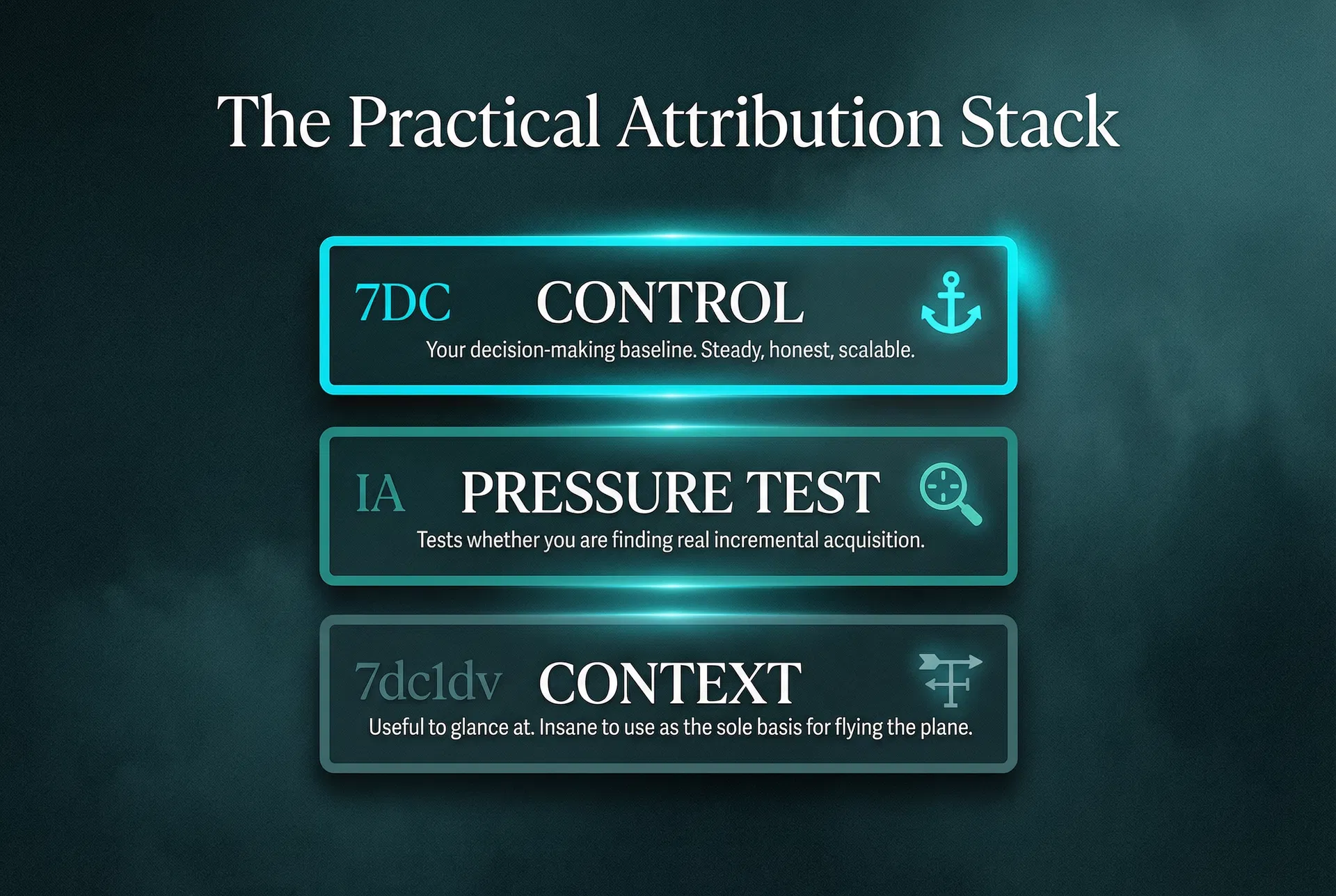
The Practical Attribution Stack
That is the cleanest model.
Use 7DC to keep your footing. Use IA to test whether you are finding real incremental acquisition. Use 7dc1dv to understand the broader halo, but not to decide where the money goes.
Especially not in categories full of delayed decisions, comparison behavior, and multi-touch conversion paths.
Which is to say: especially not in financial advertising.
The bottom line
The biggest attribution mistake in prop firms and financial brands is not under-crediting Meta.
It is over-trusting easy wins.
It is believing that low-spend efficiency automatically means scalable acquisition.
It is letting generous reporting whisper sweet little nothings into your spreadsheet while real incrementality slips quietly out the back door.
That is why the smartest framework is not: "What makes Meta look best?"
It is: "What helps us separate real lift from warm-credit theater?"
In most cases, that means:
- 7DC as the practical control
- IA as the sharper truth-serum lane
- 7dc1dv as a useful but dangerous flatterer
Financial brands do not need more attribution fairy tales. They need cleaner signal.
Because when your category is already noisy, risky, and overlap-heavy, the last thing you need is a dashboard that behaves like a hype man.
You need one that behaves like an adult.
And adults, tragically, are harder to impress.
FAQ
What is the best Meta attribution setting for prop firms?
For many prop firms, 7DC is the best practical control, while Incremental Attribution is the best setting to pressure-test whether campaigns are driving real incremental traders instead of collecting warm-credit overlap.
Is 7dc1dv bad for financial advertising?
Not always, but it is often too generous to trust as the main decision-making lens in financial categories with long consideration windows, revisits, email overlap, and branded-search spillover.
What is Incremental Attribution on Meta?
Incremental Attribution is Meta's model-based attribution setting designed to optimize ad delivery for conversions predicted to be caused by the ad rather than simply observed after exposure.
Should financial brands use Incremental Attribution?
They should at least test it, especially in retargeting, creative testing, and promo-heavy environments where standard attribution is more likely to over-credit Meta.
What budget should prop firms start testing Meta ads with?
A practical testing range for many prop firms is around $400 to $1,000 per day, with the goal of validating angles and offers before scaling toward $5,000 per day and up to $20,000 per day during high-volume periods. We break down the full platform allocation framework and seasonal timing strategy in separate guides.